Hunger is rising again.
Hunger no longer belongs in the American story.
But it's being widely misrepresented.
And misrepresentation has consequences.
How hunger gets covered and framed in everyday life determines whether Americans have accurate information or inherited myth.
Communicators are the ones who make that call.
We've sent spacecraft beyond our solar system.
We've mapped the human genome.
We developed life-saving vaccines in under a year.
We're the wealthiest nation in the history of the world.
Why are nearly 48 million Americans still hungry?
It isn't for lack of food. The United States produces so much food we pay farmers not to grow it and export our surplus to feed the world. We are not a country that struggles to grow enough. We are a country where millions of people can't afford to buy what we already produce in abundance.
Hunger in America has never been a scarcity problem. It is an income problem, an access problem, and a policy problem. When Congress temporarily expanded food assistance during the pandemic, hunger fell rapidly. When those supports ended, hunger came back. Hunger responds directly to decisions. That makes it solvable.
From humanity's earliest communities, across every major faith tradition, and among Americans who hold no religious belief at all, there is one consistent value: no one in the community should go without food. A 2014 national survey found 86 percent of Americans believe no one in this country should go hungry. That belief reflects the founding promise that in America, everyone has the chance to live a full life.
What's been missing is accurate public understanding of who is hungry, why, and what actually works.
Myths have filled that space for decades. And these long-held inaccurate beliefs, left unchallenged, shape what policymakers believe the public will accept.

1 in 7 American households
cannot consistently afford enough food. Hunger is in every county.

1 in 5 households with children
face food insecurity, nearly erasing a decade of progress.

1 in 9 seniors age 65+
face food insecurity, often choosing between groceries and medication.

1 in 5 military/veteran families
serving or who served this country face food insecurity at home.
These are not people who have failed America. They are people America has not yet gotten to.
And food insecurity is the scorecard for how we are doing on that promise.
Right now, we are not doing well. Nearly 48 million Americans live in food-insecure households. Hunger exists in every county in the country, in cities, suburbs, rural communities, on military bases and college campuses. It affects people of every background, at every income level above deep poverty. Most people experiencing hunger look nothing like the public's mental image of hunger.
That gap between reality and perception is not accidental. It is the direct result of how hunger has been covered, framed, and represented in American life.
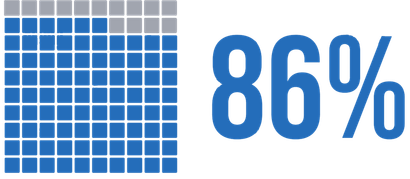
86% of Americans agree:
"In the United States of America, no one should go hungry."
Public agreement is strong.
Public demand is not.
86 percent of Americans already agree that no one in this country should go hungry.
The value is there. What's been missing is the accurate, consistent, human storytelling that turns a widely held value into a public expectation that leaders feel they cannot ignore.
That's the gap. And it's exactly where communicators make the difference.
The stories we repeat can hold hunger in place — or help end it.
Hunger in the United States is not caused by a lack of food or a lack of compassion. It is reinforced by myths that quietly and negatively shape how the public understands the problem. Ideas like:
- Hunger is rare or temporary
- People who struggle simply made bad choices
- Existing programs are wasteful or ineffective
- There isn't enough food for everyone
- There's no hunger near me and I'm not affected.
- Most people are cheating the system
- Hunger is inevitable, not solvable
These narratives do real harm. Besides being inaccurate, they lower urgency, weaken support, and make inaction feel normal.
Communicators are essential because these myths do not correct themselves. They persist when they go unchallenged — and make it easier for harmful assumptions to shape decisions that affect hungry families.
Communicators change what America considers normal.
- Seat belts became normal, not optional, because safety was reframed as shared responsibility.
- Smoking declined, not just through regulation, but through sustained storytelling that changed social norms.
- HIV/AIDS moved out of silence, because advocates, journalists, and creators refused to let it remain invisible.
- Drunk driving became unacceptable because campaigns changed what people expected of one another.
In each case, the turning point wasn't a law or a campaign. It was a change in how the story was told, repeated in enough trusted places that the public's latent values became active expectations.
Every day, in news, entertainment, advertising, fashion, sports, and social media, communicators and creators are shaping what feels urgent, what feels normal or desirable, and what feels like someone else's problem. That's not advocacy. That's the job. Hunger has rarely been in that frame. Not because communicators don't care, but because the accurate picture hasn't been easy to find.
When communicators get the facts right on hunger, several things follow naturally. Myths lose their grip. Programs that work get described accurately instead of mischaracterized. Real people are seen as they are, not as a stereotype. And the public has what it needs to form its own expectations.
None of that requires adopting a position. It just requires accuracy.
If your work shapes what people see, hear, or believe, you already have a role in whether hunger remains easy to ignore.
This work didn't start yesterday.
For more than four decades, the End Hunger Network has worked to make sure hunger is understood accurately in American public life. From shaping the messaging for the Live Aid broadcast in 1985, which reached nearly two billion people worldwide, to the first coordinated national multi-influencer, one-day social media campaign for ending hunger in 2024, the through-line has always been the same: better information leads to better decisions.
The End Hunger Network's Communications Hub exists to give communicators what they need to get this story right. Sourced explainers on SNAP, WIC, and school meal programs. Current policy context tied to what's in the news right now. Data by state, county, and congressional district. Expert contacts for on-the-record sourcing. And plain-language clarifications of the specific claims circulating in political messaging and media coverage that don't match the evidence.
Nothing in the Hub asks you to adopt a position. It exists so that when hunger comes up in your work, you have the facts at hand.
Hunger is waiting for that moment. The facts are clear. The values are already there.
Ending hunger in America is an idea whose time has come.