Hunger in the United States is real.
It is widespread.
And it is solvable.
Hunger exists in every community.
Hunger in the United States is not confined to one region, demographic, or moment of crisis. It affects urban neighborhoods, rural towns, suburbs, and college campuses. It affects children, seniors, working adults, veterans, and families who are employed but struggling to make ends meet.
Today, more than one in seven U.S. households experiences food insecurity at some point during the year. For families with children, the rate is higher. These are not isolated cases. They reflect a persistent condition affecting millions of households nationwide.
Hunger is often hidden. People may skip meals, stretch food budgets, rely on inexpensive but unhealthy options, or quietly seek help from food pantries and community programs. Because it is often managed privately, hunger can remain invisible even when it is widespread.
Hunger affects millions of people in communities across the country, not because food is scarce or compassion is lacking, but because access is uneven and understanding remains incomplete.
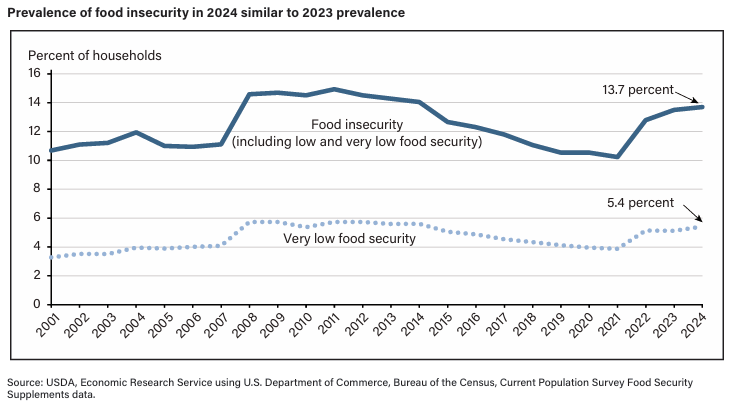
This chart shows the share of U.S. households experiencing food insecurity over time, including households with children, using the most recent data available from the U.S. Department of Agriculture. After years of gradual improvement, food insecurity has risen again since the pandemic, with households with children consistently experiencing higher rates. Note: The USDA announced that it will no longer produce this important report, although there is legislation moving through Congress requiring its continuation (H.R. 6252)
The recent rise in food insecurity follows disruptions such as the COVID-19 pandemic and rising inflation, which exposed how vulnerable many households are to economic shocks. The continuation of hunger beyond emergency periods highlights the need for sustained attention, not temporary response.
Understanding hunger accurately matters.
Hunger in the United States is not caused by a lack of food. The country produces more than enough food to feed everyone. Hunger is the result of barriers to access, including income instability, rising housing and healthcare costs, geographic isolation, and gaps in support systems.
It is also not a reflection of personal failure. Many people experiencing hunger are working, caring for family members, or living on fixed incomes. Hunger often arises from circumstances, not choices.
How hunger is understood shapes how seriously it is addressed. When hunger is framed as rare, temporary, or inevitable, urgency fades. When it is understood as widespread and solvable, solutions become possible.
Why hunger is often misunderstood.
Several persistent myths continue to shape public understanding of hunger, even when they are inaccurate.
- Hunger is rare or temporary
- People who experience hunger made poor choices
- Food assistance programs are wasteful or ineffective
- There isn’t enough food to go around
- Hunger doesn’t affect my community
- Most people receiving help are abusing the system
- Hunger is inevitable and cannot be solved
These ideas persist not because they are true, but because they often go unchallenged. When misinformation shapes public understanding, it lowers urgency, weakens support for effective programs, and makes inaction feel acceptable.
Most Americans agree. Action still lags.
A strong majority of Americans believe that no one in the United States should go hungry. Yet hunger remains widespread.
The gap is not one of values. It is a gap of attention, understanding, and expectation.
When hunger fades from view, urgency fades with it. When stories appear only during crises, attention drifts. And when expectations weaken, accountability follows. Sustained progress depends not only on programs and policies, but on whether hunger remains visible, understood, and taken seriously over time.
How hunger is talked about shapes what happens next.
Public understanding influences public will. Public will influences policy, funding, and institutional response.
Stories shape what people notice, what they believe is possible, and what they expect leaders to address. When hunger is presented with accuracy, dignity, and context, support for effective solutions grows. When it is framed narrowly or inaccurately, progress stalls.
That is why communication is not peripheral to hunger work. It is central to it.
A shared foundation for accurate understanding.
The End Hunger Network exists to help strengthen public understanding of hunger in the United States by convening communicators, sharing accurate context, and reinforcing narratives that reflect reality.
This site is designed to serve as a shared reference point. It is not prescriptive. It does not ask for one voice or one message. It provides context, facts, and framing that communicators can adapt to their own work, audiences, and platforms.
For people whose work influences public understanding, how hunger is framed matters.